





Building back better with BREEAM

Contents |
[edit] Introduction
The COVID-19 pandemic has caused an unprecedented public health crisis and the most significant economic shock since the Great Depression, exposing weaknesses in our economy and society. It has also demonstrated what society can achieve by working for a common goal against a common threat.
Demand for a return to a better normal is increasing with the spotlight being shone on global issues - the impending threat of climate change being most prevalent. Without action, the global climate change crisis will cause social and economic damage far greater than those caused by COVID-19.
Together, buildings and construction are responsible for 39% of all carbon emissions. We must build back better.
BREEAM is well placed to help the built environment achieve this in a meaningful way. BREEAM was the world’s first sustainability rating, and BREEAM standards are tailored to address the unique aspects of each life cycle stage in the built environment. BREEAM standards support investors, developers, clients and stakeholders to deliver and validate the sustainability value of their assets and, in doing so, create higher values and lower risks. BREEAM works by bringing multiple disciplines together to focus on one common, holistic framework. It sets performance levels to support a consistent method and offers tradeable and flexibility.
[edit] The BREEAM Building Back Better Hub
BREEAM has been considering its role and responsibility in the effort to build back better. BREEAM’s contribution can be explored in the overarching briefing hub ‘Building Back Better with BREEAM: Supporting the green recovery’.
This resource serves to provide an overview of the various environmental, economic and social issues that BREEAM addresses. The BREEAM position on each of these issues will be detailed in specific briefing papers that will be released over time as the organisation works through the COVID-19 challenge.
The specific topic areas include:
- Net Zero Carbon
- Circular Economy
- Health
- Social Impact
- Resilience
- Natural Environment
- Quality and Whole Life Performance
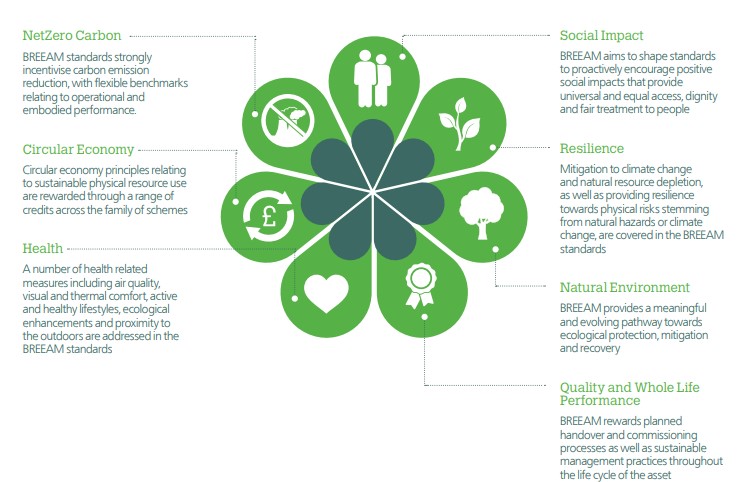
Find out more at: https://www.breeam.com/building-back-better/.
[edit] Related articles on Designing Buildings Wiki
- BRE articles on Designing Buildings Wiki.
- BREEAM Awards 2021.
- BREEAM Life cycle cost and service life planning.
- BREEAM: The Next Generation.
- Building Back Better: Health.
- Building Back Better: Net zero carbon and BREEAM.
- Building Back Better: Resilience.
- Building Back Better: Social impact.
- Circular economy.
- Health in the built environment.
- Natural environment.
- Net zero carbon 2050.
- Resilience.
- Social Sustainability at Master-planning Stage.
- Whole life costs.
[edit] External resources
Featured articles
Check out some of the best features and news from Designing Buildings as well as key stories from around the web.

Government approach could undermine delivery and regeneration.
World's first mass timber data centre.

The overlooked environmental aspect of data centre development.
Introduction to radon awareness

New technical information sheet published by CIOB.

Updated supplier guide can help electrical contractors engage with NHP.

CIAT confirm the winners of the 2026 architectural technology awards.

Government launches a one stop shop for flood preparedness.

Sir Edwin Lutyens: Britain's greatest architect? Book review.

CIOB publishes free template to help assess and manage risks.
ECA's reflections on Party Conference season

Burnham wants to be confident of winning before asking for a fresh mandate.
New Chief Construction and Scientific Adviser

Sergio Cavalaro, Professor of Infrastructure Systems at Loughborough University.
Building safety levy for England

CIAT publish estimator tool for members.

Water sector faces a growing crisis that could slow the delivery of vital infrastructure.